
COUNTRY REFERENCE
Germany income tax rates in 2026
- What is the top income tax rate in Germany (2026)?
- The top marginal income tax rate is 45% (2026).
These are the 2026 brackets an employer in Germany withholds against. They tell you the marginal rate on each slice of income — not the amount you will actually pay, which is lower once the country's deductions and credits are applied.
Germany income tax brackets for 2026
| Taxable income | Income tax | Combined |
|---|---|---|
| €0 — €12,348 | 0% | 0% |
| €12,348 — €17,799 | 14% → 23.97% | — |
| €17,799 — €69,878 | 23.97% → 42% | — |
| €69,878 — €277,825 | 42% | 42% |
| Above €277,825 | 45% | 45% |
Before you use these:German income tax is defined by a formula, not by flat bands: inside the second and third zones the marginal rate rises continuously, so no single percentage applies to a whole zone. The marginal rates shown at each end of a zone are derived from the coefficients in §32a of the Income Tax Act. Social contributions — health, long-term care, pension and unemployment insurance — are charged separately and are not part of these rates. A solidarity surcharge applies to higher incomes, and church tax applies if you are registered with a church. Neither is included here.
What these rates do not tell you
- The net figures below apply only the reliefs we have sourced from the tax authority for this country, and no others. Reliefs that depend on your circumstances — dependants, a mortgage, a partner's income — are not among them, and each of them moves the result further in your favour. The net figure is therefore a floor, not a promise.
Employer contributions, currency conversion and what a net-pay figure does and does not model: how we work with these numbers.
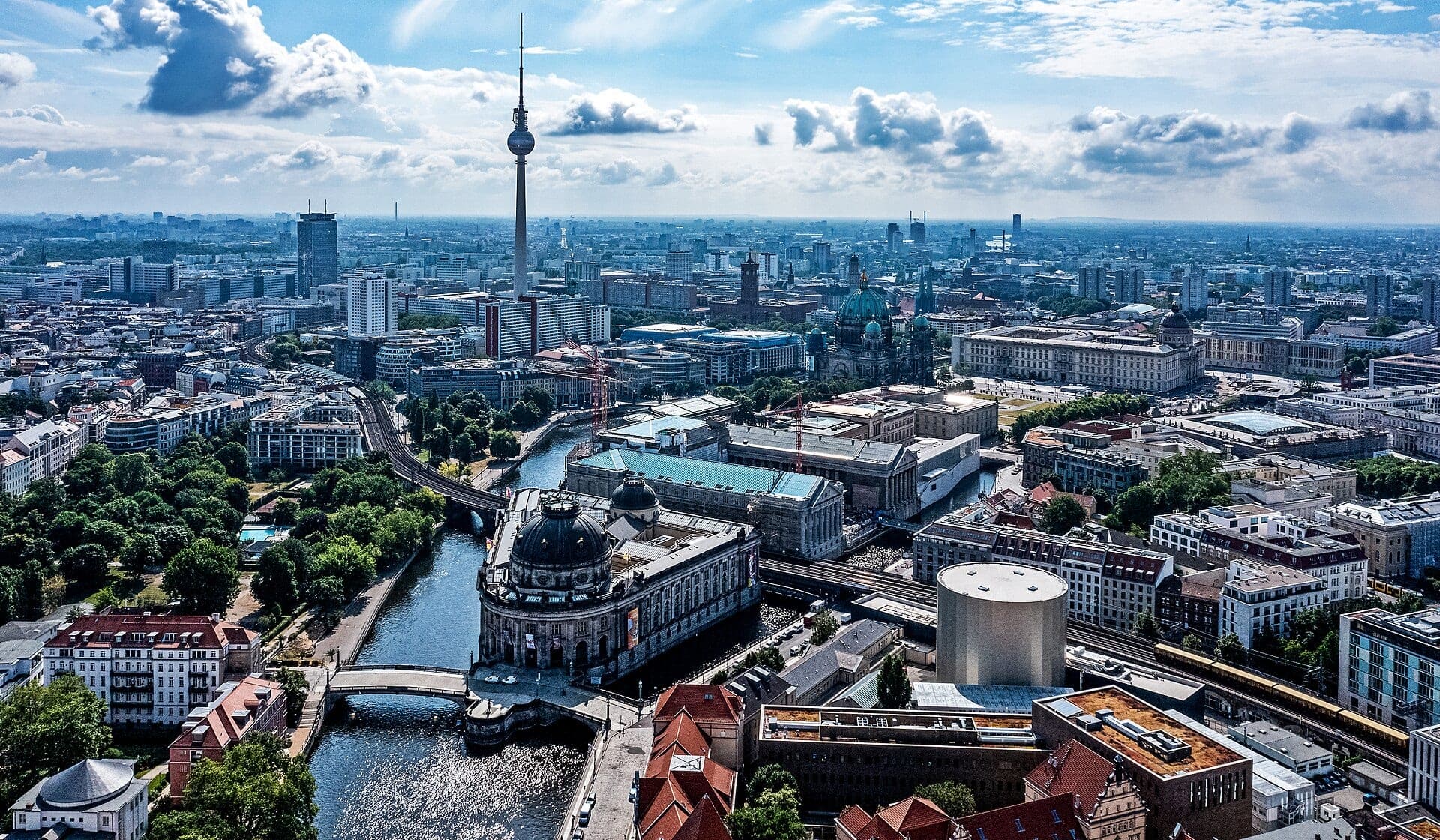
Photo: Kasa Fue, derivative work by Georgfotoart · CC BY-SA 4.0

Photo: Dietmar Rabich · CC BY-SA 4.0
More about Germany
- Germany income tax brackets: 2024, 2025 and 2026 compared
The rates have not changed in three years — 14%, 42% and 45% are identical throughout. Every threshold moved. And the 2024 figure most sources print is superseded.
- Why Germany's Blue Card salary changes every January
Germany does not decide the figure. It is calculated from the pension insurance ceiling, which means it moves every year without anyone announcing a policy change.
- Moving from the Netherlands to Germany
- Moving from the United Kingdom to Germany
- Moving from Germany to the Netherlands
What is left after tax and contributions in Germany
The rates in the table above are marginal income tax — what the next euro is taxed at. They are not what leaves your salary. Social security is charged separately and comes to roughly a fifth of gross pay, and the income tax itself is charged on a figure well below your gross, because those contributions are deducted first.
The part almost nobody states: contributions stop at a ceiling, and there are two of them. Health and long-term care stop at €69,750; pension and unemployment stop at €101,400. Above each of those points a raise attracts no further contributions at all, so the share of gross pay going into social security falls — the one thing a single-figure calculator cannot show you.
| Gross a year | Social security | Taxed on | Income tax | Solidarity surcharge | Net a year | Net a month | Contributions as % of gross | All deductions |
|---|---|---|---|---|---|---|---|---|
| €30,000 | €6,560 | €22,671 | €2,243 | none | €21,198 | €1,766 | 21.9% | 29.3% |
| €45,000 | €9,839 | €34,639 | €5,562 | none | €29,599 | €2,467 | 21.9% | 34.2% |
| €60,000 | €13,119 | €46,608 | €9,376 | none | €37,505 | €3,125 | 21.9% | 37.5% |
| €69,750 | €15,251 | €54,387 | €12,122 | none | €42,377 | €3,531 | 21.9% | 39.2% |
| €85,000 | €16,867 | €68,219 | €17,520 | none | €50,613 | €4,218 | 19.8% | 40.5% |
| €101,400 | €18,606 | €83,094 | €23,763 | €406 | €58,625 | €4,885 | 18.3% | 42.2% |
| €130,000 | €18,606 | €111,694 | €35,775 | €1,836 | €73,784 | €6,149 | 14.3% | 43.2% |
For a single employee with no other income, in a statutory health fund, with no children and no church tax. Your own tax class does not change the figures above: classes decide how much is withheld each month, and for a single person with one job the annual tax is the same whichever one applies.
These are figures for the tax you finally owe for the year, not for the amount withheld from each payslip. The two are not the same number: withholding is worked out from a simplified standard figure for your insurance contributions, while the annual assessment uses what you actually paid. On a salary of €60,000 the gap runs to about ten euros a year — small, but it is the reason a payslip calculator and a tax return rarely agree to the cent, and neither of them is wrong.
What this does not include
- Your fund’s own rate. Every statutory health fund sets its own supplementary contribution, so there is no single German net figure. The table uses the average the health ministry reports funds actually charging.
- Children. The childless surcharge above is carried by the employee alone. Parents pay less instead, and the reduction grows with each child from the second to the fifth.
- Church tax, marriage or joint assessment, a mortgage, a second income, and voluntary contributions beyond the statutory ones.
- Private health insurance. Above €77,400 a year you may leave the statutory system, and the whole calculation changes.
What the authorities say
§ 341 (2) SGB III, split evenly. Unlike pension, health and care contributions, this one is not deductible from taxable income: § 10 (1) EStG does not list it.
§ 9a sentence 1 no. 1a EStG. Deducted from employment income automatically; you only itemise if your actual work expenses come to more.
§ 4 (1) 2 of the 2026 regulation. It has nothing to do with an ordinary employee’s own contributions — it is kept because § 10 (3) EStG defines the ceiling on deductible pension contributions as the maximum contribution to this scheme, a figure published nowhere in euros and therefore worked out from this amount and the miners’ rate.
§ 2 (2) of the 2026 regulation. Health and long-term care contributions stop growing here — more than €31,000 below the pension ceiling, which is why the effective burden has two separate steps down rather than one.
§ 4 (1) 1 of the 2026 regulation. Earnings above this stop attracting pension and unemployment contributions altogether — so the share of gross that goes into contributions falls once you pass it. The same ceiling governs unemployment insurance through § 341 (3) SGB III.
§ 10 (1) no. 3a sentence 4 EStG: where the contributions can give rise to a sick-pay entitlement — and for an employee they do — the deductible amount is reduced by 4 per cent. What is deductible is basic cover, not the part that buys sick pay.
§ 241 SGB V, split evenly. This is only part of what you pay for health cover — every fund adds a supplementary rate of its own on top.
The average rate health funds actually charge, as stated by the health ministry for 1 April 2026, split evenly since 2019. It is not the same as the average rate the ministry sets in advance under § 242a SGB V, which for 2026 is 2.9 per cent: that one is a forecast made before the year starts, and funds ended up charging more. Your own fund charges its own rate, so no single German net figure exists — this is the closest honest stand-in.
Set to 3.6 per cent from 1 January 2025 by government regulation (PBAV 2025), split evenly. Reading the statute alone gives the wrong number: § 55 (1) SGB XI still says 3.4 per cent, because the regulation adjusts the rate without amending the text of the law.
§ 55 (3) SGB XI, from the month after your 23rd birthday. The employee carries it alone, so it costs six times what it looks like next to the half-and-half rates. Parents pay less instead: 0.25 points off for each child from the second to the fifth, until that child turns 25.
Announced for each year under § 158 (4) SGB VI. Employer and employee each pay half. The 2026 announcement of 24 November 2025 says the rate „remains“ 18.6 per cent.
Kept for the same reason as the miners’ ceiling: together they produce the cap on deductible pension contributions under § 10 (3) EStG.
§ 3 (3) no. 2 SolzG 1995. The threshold is expressed in tax, not in salary: below this much income tax there is no surcharge at all. § 6 (27) confirms this version applies from assessment year 2026. For jointly assessed couples the figure is €40,700.
§ 4 sentence 2 SolzG 1995: just above the threshold the surcharge may not exceed 11.9 per cent of the amount by which the tax exceeds the threshold. Without it, one euro of tax over the line would cost more than a thousand euros of surcharge.
§ 4 sentence 1 SolzG 1995. Charged on the income tax, not on income — which is why quoting it as „5.5 per cent“ next to tax rates misleads: most employees pay none of it at all.
§ 10c EStG. Small, and included because leaving it out would make the figures fail to reconcile against the tax office’s own arithmetic.
Where these figures come from
- Beitragssatz zur Arbeitslosenversicherung — Bundesministerium der Justiz, checked 2026-09-06
- Arbeitnehmer-Pauschbetrag — Bundesministerium der Justiz, checked 2026-09-06
- Beitragsbemessungsgrenze in der allgemeinen Rentenversicherung — Bundesgesetzblatt, checked 2026-09-06
- Sonderausgaben-Pauschbetrag — Bundesministerium der Justiz, checked 2026-09-06
- Allgemeiner Beitragssatz in der Krankenversicherung — Bundesministerium der Justiz, checked 2026-09-06
- Durchschnittlich erhobener Zusatzbeitragssatz — Bundesministerium für Gesundheit, checked 2026-09-06
- Beitragssatz in der sozialen Pflegeversicherung — Bundesgesetzblatt, checked 2026-09-06
- Beitragszuschlag für Kinderlose — Bundesministerium der Justiz, checked 2026-09-06
- Beitragssatz in der knappschaftlichen Rentenversicherung — Bundesgesetzblatt, checked 2026-09-06
- Solidaritätszuschlag — Bundesministerium der Justiz, checked 2026-09-06
Quoting a figure from this page
Every number here is checked against the authority that publishes it, on the date shown. Those numbers change without announcement — one on this site was correct for three months and then quietly was not. So if you quote a figure, quote the date with it, and check the source before you rely on it.
Career Space, “Germany income tax rates in 2026”. Checked 2026-08-11. https://career-space.com/en/salary/germany
Sources
- 01§ 32a EStG — EinkommensteuertarifBundesministerium der Justiz — Gesetze im Internet ·
Every figure here comes from an official source and carries the date we checked it. How we work with data.
This page is information, not advice. We are not an employer, a recruitment agency, a visa centre or an immigration adviser, and we are not affiliated with any government body. Rules change — confirm against the official source before you act.