
Country reference
Spain work permits and salary thresholds

Photo: Zarateman · CC0
- What is the 2026 salary threshold for the EU Blue Card in Spain?
- €41,356 per year (2026).
- Does the EU Blue Card in Spain require a job offer?
- Yes. A signed job offer or employment contract is part of the application.
EU Blue Card
Spain's EU Blue Card has a salary bar but not a salary figure. An order published on 30 January 2026 sets it as 1.4 times the average gross annual earnings per worker, as measured by the national statistics institute — so the amount moves when the statistics move, without the rule itself being amended. It moved when the institute published the 2024 average of €29,540.26 on 28 May 2026, and applies to applications filed from a month after that. Against that edition the bar is €41,356.36 a year, or €33,085.09 where a reduction applies.
Salary threshold by year
- Standard
- €41,356
- Reduced criterion
- €33,085
What the amount is:Per year, and derived rather than quoted: the order names no euro figure at all. It sets the bar at 1.4 times the average gross annual earnings per worker measured by the national statistics institute, with a coefficient of 0.8 where a reduction applies. On 28 May 2026 that institute published the figure for 2024, €29,540.26, and in June 2026 the ministry republished the thresholds against it: 29,540.26 × 1.4 = €41,356.36, and × 0.8 again = €33,085.09. Until 29 August 2026 this page carried €39,269.92, which was 1.4 times the 2023 average — correct against the survey then in force, and out of date the moment the new one appeared.
Does your offer clear the threshold?
The comparison runs in your browser. Nothing you type is sent anywhere, stored or logged. It checks your figure against the published threshold — it is not a tax calculation and not advice.
Conditions
- A job offer in Spain for a managerial position, or for work requiring a higher education qualification — or, exceptionally, at least three years of professional experience the authorities accept as equivalent.
- Pay at or above the reference threshold. The threshold is expressed as a multiple, not an amount: 1.4 times the average gross annual earnings per worker from the national salary structure survey.
- The arithmetic behind the figure on this page: the survey currently in force covers 2024 and reports an average of €29,540.26, published on 28 May 2026. Multiplied by 1.4 that gives €41,356.36 a year. The order itself contains no euro amount, so any page quoting one — including this one — is showing you a derivation and should show you the working.
- A reduction coefficient of 0.8 applies in two cases. It multiplies the reference threshold, not the average, so the chain is 1.4 × 0.8 = 1.12 times the average, or €33,085.09 a year. The two cases are: occupations in the first two groups of the national occupation classification that appear in the shortage occupation catalogue, and applicants who obtained the qualification they are relying on no more than three years before applying.
- The bar changes on its own schedule. When the statistics institute publishes a new edition of the survey, the new threshold applies to applications filed from one month after that publication. The date that matters for your case is therefore not the date the statistics appear, and an application filed inside that month is still judged against the old figure.
- This page was wrong until 29 August 2026, and it is worth saying why rather than editing it away. It carried the predecessor figure, €39,269.92, which was 1.4 times the 2023 average. That was right when we published it and stopped being right once the 28 May 2026 average took effect a month later, two months before we noticed. A threshold defined as a formula does not announce itself when it moves — which is exactly the failure mode this page warns you about, and we walked into it.
- Authorisations granted before the order came into force keep their validity, so the new bar is a rule for new applications rather than a re-test of existing ones.
- This is not Spain's only highly qualified route. The national authorisation sits under the same law and, since the ministry's June 2026 update, carries the same figure — €41,356.36 — with one difference that can decide your case: it has no reduced threshold at all. See the route below.
National highly qualified professional authorisation
Spain's second highly qualified route, under article 71.2.b of Ley 14/2013. Since the ministry's June 2026 update it costs exactly what the EU Blue Card costs — €41,356.36 a year — and the ministry says in the same document that the reduced threshold does not apply here. So the two routes are priced identically at the top and differ only at the bottom: the Blue Card can come down to €33,085.09, this one cannot.
Salary threshold by year
- Standard
- €41,356
What the amount is:Per year. The ministry's June 2026 update states a single threshold of €41,356.36 for the national authorisation under article 71.2.b, and states explicitly that no reduced threshold applies to it. The figure is the same 1.4 times the 2024 average earnings of €29,540.26 that produces the general Blue Card bar; what the national route does not have is the 0.8 coefficient.
Does your offer clear the threshold?
The comparison runs in your browser. Nothing you type is sent anywhere, stored or logged. It checks your figure against the published threshold — it is not a tax calculation and not advice.
Conditions
- A job offer in Spain in a highly qualified role, from a company established in Spain.
- Pay of at least €41,356.36 a year. This is a single threshold: the ministry's June 2026 update states, in as many words, that no reduced threshold applies to the national authorisation.
- The figure is derived the same way as the Blue Card's general bar — 1.4 times the €29,540.26 average gross annual earnings the statistics institute published for 2024 on 28 May 2026 — and it therefore moves on the same statistical schedule.
- Which route is better for you does not turn on the amount, because the amount is now identical. It turns on whether you can reach the reduction: an occupation in the first two groups of the national classification that appears in the shortage catalogue, or a qualification obtained within the three years before applying. If either applies, the Blue Card asks €8,271.27 a year less. If neither applies, the two routes ask the same salary.
- Figures different from this one — €54,142 and €40,077 are the two we saw most often — circulate widely in advisers' write-ups. They do not match the ministry's current publication, and none of the pages printing them cite the order or the update. We name the discrepancy rather than guess at its cause.
- The Blue Card carries rights the national authorisation does not, notably movement to other EU member states. This page compares the salary condition, which is the part people are usually stuck on; it does not claim the routes are otherwise equivalent.

Photo: M McBey · CC BY 2.0
Is that threshold actually high?
A salary threshold means nothing on its own. Here it is next to what people in the country are actually paid, using official statistics you can check yourself.
1.51× the median full-time wage. That is what the visa threshold asks for.
- Median full-time pay (2022)
- €27,440 a year
- Eurostat structure of earnings survey, run every four years; full-time employees, industry, construction and services excluding public administration.
- Average full-time pay (2022)
- €32,814 a year
- Eurostat structure of earnings survey, run every four years; full-time employees, industry, construction and services excluding public administration.
- Statutory minimum, per month (2026-S2)
- €1,425
- Eurostat; statutory monthly minimum wage, gross, revised twice a year.
Earnings come from each country's official statistics, and every authority publishes on its own schedule — the period is shown next to each figure, and the publisher under it. Statutory minimum wages are revised twice a year and are current.
The ratio compares the current threshold with the most recent earnings survey, so the two figures are from different years. Treat it as an order of magnitude, not a precise multiple.
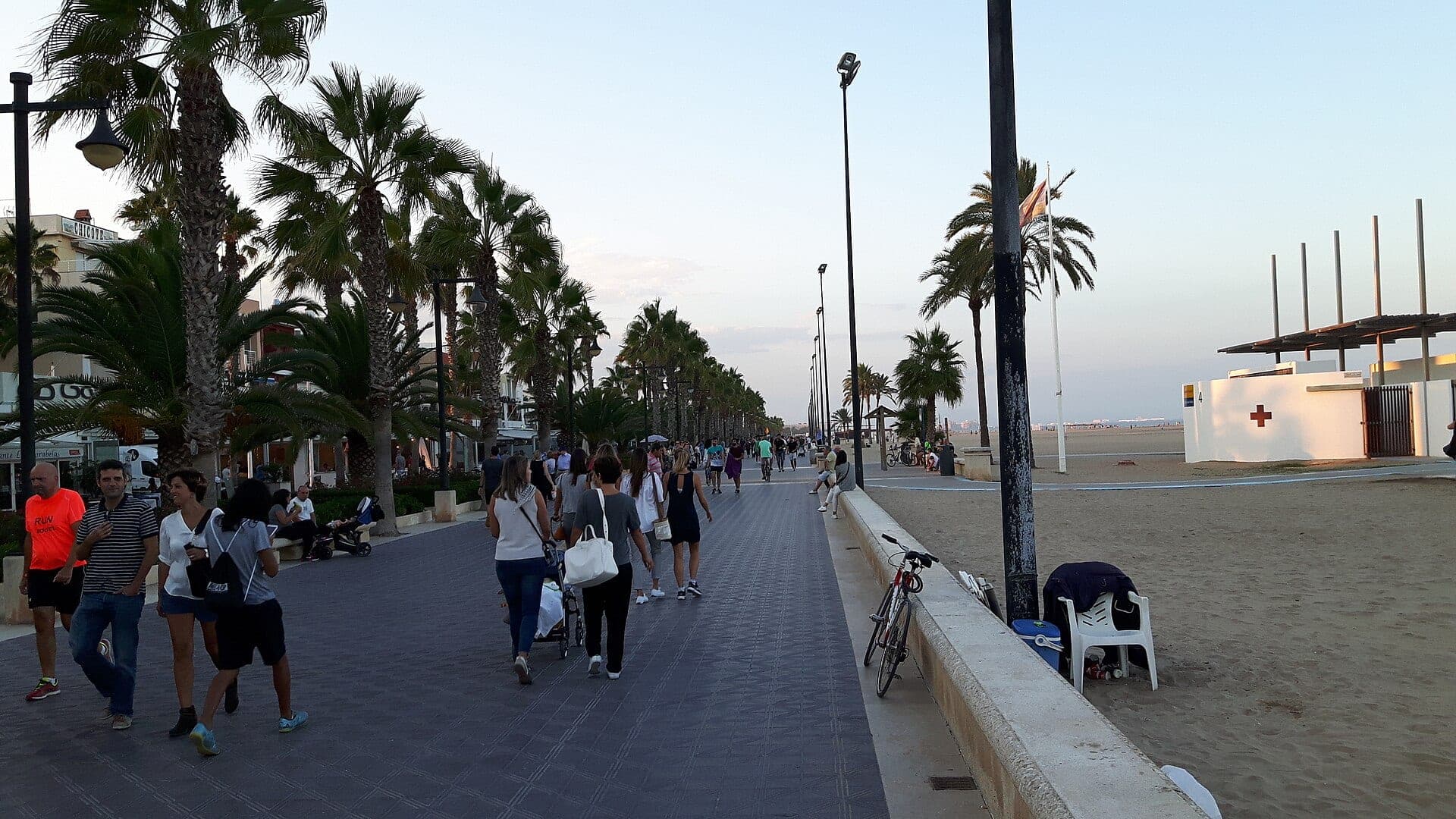
Photo: Boris Dzhingarov · CC BY 2.0
More about Spain
- Spain's digital nomad visa income requirement, derived from the law
For 2026 the figure is €2,849 a month for a single applicant. Here is the arithmetic it comes from — and why the other numbers you have seen are not wrong so much as answering a different question.
- Spain's two highly qualified routes now ask the same salary
€41,356.36 a year, either way. The EU Blue Card and the national authorisation were priced apart for years; since June 2026 they are not. The difference that is left is whether you can qualify for less.
- Moving from the Netherlands to Spain
- Moving from Spain to Portugal
Quoting a figure from this page
Every number here is checked against the authority that publishes it, on the date shown. Those numbers change without announcement — one on this site was correct for three months and then quietly was not. So if you quote a figure, quote the date with it, and check the source before you rely on it.
Career Space, “Spain work permits and salary thresholds”. Checked 2026-08-29. https://career-space.com/en/visa/spain
Sources
- 01Actualización del umbral salarial para profesionales altamente cualificados titulares de tarjeta Azul (Junio 2026)Ministerio de Inclusión, Seguridad Social y Migraciones ·
- 02Encuesta Anual de Estructura Salarial (EAES). Últimos datos: sueldo medio 2024Instituto Nacional de Estadística ·
- 03Orden PJC/44/2026, de 27 de enero, por la que se establece el umbral salarial de referencia para la autorización de residencia para profesionales altamente cualificados titulares de una Tarjeta azul-UE (Ley 14/2013)Boletín Oficial del Estado ·
- 04Monthly minimum wages (earn_mw_cur)Eurostat ·
- 05Structure of earnings survey: annual earnings (earn_ses_annual)Eurostat ·
Every figure here comes from an official source and carries the date we checked it. How we work with data.
This page is information, not advice. We are not an employer, a recruitment agency, a visa centre or an immigration adviser, and we are not affiliated with any government body. Rules change — confirm against the official source before you act.